Scientific Chaitanya Research Center for Krishna Consciousness

Quantum mechanics is a very important topic of physics to discuss and analyse. Quantum mechanics says that elementary particles such as photons, electrons, quarks or even atoms are always in a state of superposition. What does it mean? It means that the elementary particles can exist at multiple positions(taking into account just one observable) simultaneously (at the same time). One can only predict the position of a particle at a given time using theory of probabilities. Once the position of the particle is measured precisely, the superimposed state collapses into a single state.

Lord Krishna did the same thing during his childhood in the Dwapar yuga. In dwapar yuga absolute /Parambrahmma took incarnation as Sri Krishna. Lord Brahmmaa the creator of everything of this universe did not want to believe that the little child Sri Krishna was the absolute. He kidnapped ten thousand cows and cowboys of child Krishna’s childhood friends. When child Krishna was able to know that Lord Brahmmaa kidnapped his friends and cows, Krishna then and then within a moment expressed himself into many. He manifested himself as ten thousand cows and cowboy-friends. After seven days Lord Brahmmaa came back to observe what Krishna did in absence of his cows and cowboy-friends.
Lord Brahmma was astonished, surprised and amazed to see that child Sri Krishna was
playing with his ten thousand cows and cowboy-friends whom he stolen. Lord Brahmmaa returned to his
hidden place where he kept Krishna’s cows and cowboy-friends. Lord Brahmmaa was afraid of observing
ten thousand cows and cowboys with him in his hidden place and another ten thousand same copies of
cows and cowboys playing with child Sri Krishna at vrindaban forests. Lord Brahmmaa saw two copies
of ten thousand cows and cowboys. One copy of ten thousand cows and cowboys with himself and another
same copy of ten thousand cows and cowboys with child Sri Krishna. Then Lord Brahmmaa was able to
understand his mistake and apologized and begged mercy/pardon to Sri Krishna.
Similarly during adolescence Lord Sri Krishna expressed himself into many adolescent Krishna to make
friendship and observe transcendental love with the hundreds of thousands of gopinies or girlfriends
of vrindaban during maharaas lila. Thousands of same looking adolescent Sri Krishna were playing
with thousands of gopinies/girlfriends of vrindaban during full moon night or raas-purnima.

So this is the scientific explanation of expression of one into many of Lord Sri Krishna. He is a great meditationist/yogi. By hard meditation he can do anything like magic.
Quantum mechanics says that elementary particles are dual in nature i. e. they are waves as well as particles. Photons are waves (quanta of electromagnetic waves) as well as particles. Similarly electrons are waves as well as particles i. e. dual state of existence with multiple positions at the same time i. e. superposition. When there is any observer, they behave like particles but in absence of observer they behave like waves. Double slit experiment proves that in presence of detector or observer they act as particles otherwise they are waves. Waves have no form; they are formless. But particles have form and figure. Vedanta philosophy (Adwaita philosophy or non-dualistic theory) says that the absolute Brahma is formless and figureless. Vedantist Shankaracharya said, “Sarvam Khalbidam Brahma” (The absolute pervades all); “Aham Brahmasmi” (I am the absolute) which has neither figure nor form).
But another sage Madhyacharya says that the absolute (God) has dual existence i. e. having form and figure as well as formless. Accordingly Lord Chaitanya Mahapravu believed that God (Sri Krishna) has dual existence i. e. Lord Sri Krishna (having form and figure) and Lord Jagannath (has apparent form, no complete figure). The Higgs boson, sometimes called the Higgs particle, is an elementary particle in the Standard Model of particle physics produced by the quantum excitation of the Higgs field, one of the fields in particle physics theory. In the Standard Model, the Higgs particle is a massive scalar boson with zero spin, even (positive) parity, no electric charge, and no colour charge that couples to (interacts with) mass. It is also very unstable, decaying into other particles almost immediately upon generation.
The Higgs field is a scalar field with two neutral and two electrically charged components that form a complex doublet of the weak isospin SU(2) symmetry. Its "Mexican hat-shaped" potential leads it to take a nonzero value everywhere (including otherwise empty space), which breaks the weak isospin symmetry of the electroweak interaction and, via the Higgs mechanism, gives mass to many particles.
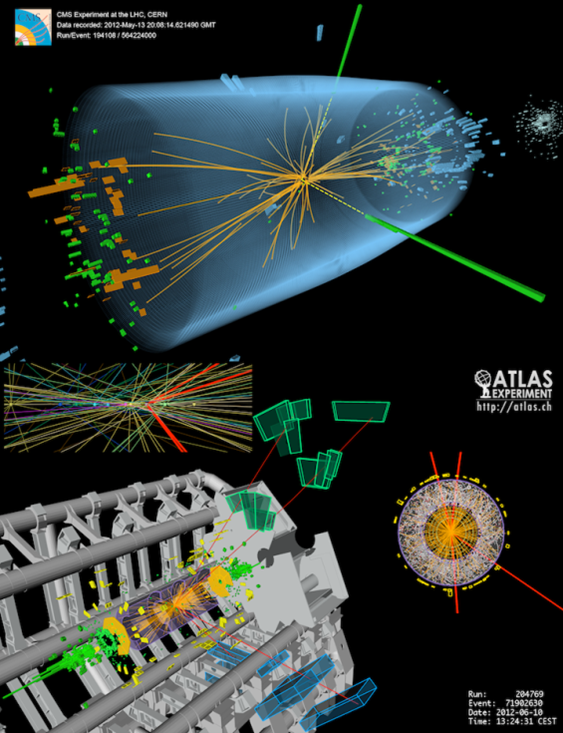
Both the field and the boson are named after physicist Peter Higgs, who in 1964, along with five other scientists in three teams, proposed the Higgs mechanism, a way for some particles to acquire mass. (All fundamental particles known at the time[c] should be massless at very high energies, but fully explaining how some particles gain mass at lower energies had been extremely difficult.) If these ideas were correct, a particle known as a scalar boson should also exist (with certain properties). This particle was called the Higgs boson and could be used to test whether the Higgs field was the correct explanation. After a 40 year search, a subatomic particle with the expected properties was discovered in 2012 by the ATLAS and CMS experiments at the Large Hadron Collider (LHC) at CERN near Geneva, Switzerland. The new particle was subsequently confirmed to match the expected properties of a Higgs boson. Physicists from two of the three teams, Peter Higgs and François Englert, were awarded the Nobel Prize in Physics in 2013 for their theoretical predictions. Although Higgs's name has come to be associated with this theory, several researchers between about 1960 and 1972 independently developed different parts of it. In the mainstream media, the Higgs boson is sometimes called the "God particle" after the 1993 book The God Particle by Nobel Laureate Leon Lederman, although the nickname has been criticised by many physicists.
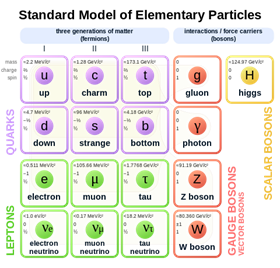
The Standard Model includes a field of the kind needed to "break" electroweak symmetry and give particles their correct mass. This field, called the "Higgs Field", exists throughout space, and it breaks some symmetry laws of the electroweak interaction, triggering the Higgs mechanism. It therefore causes the W and Z gauge bosons of the weak force to be massive at all temperatures below an extreme high value.[g] When the weak force bosons acquire mass, this affects the distance they can freely travel, which becomes very small, also matching experimental findings.[h] Furthermore, it was later realised that the same field would also explain, in a different way, why other fundamental constituents of matter (including electrons and quarks) have mass. Unlike all other known fields such as the electromagnetic field, the Higgs field is a scalar field, and has a non-zero average value in vacuum.
The "Mexican hat-shaped" potential of the Higgs field is responsible for some particles gaining mass. In the Standard Model, the Higgs boson is a massive scalar boson whose mass must be found experimentally. Its mass has been determined to be 125.35±0.15 GeV/c2.[35] It is the only particle that remains massive even at very high energies. It has zero spin, even (positive) parity, no electric charge, and no colour charge, and it couples to (interacts with) mass.[13] It is also very unstable, decaying into other particles almost immediately via several possible pathways. The Higgs field is a scalar field, with two neutral and two electrically charged components that form a complex doublet of the weak isospin SU(2) symmetry. Unlike any other known quantum field, it has a "Mexican hat-shaped" potential. This shape means that below extremely high energies of about 159.5±1.5 GeV[36] such as those seen during the first picosecond (10−12 s) of the Big Bang, the Higgs field in its ground state takes less energy to have a nonzero vacuum expectation (value) than a zero value. Therefore in today's universe the Higgs field has a nonzero value everywhere (including otherwise empty space). This nonzero value in turn breaks the weak isospin SU(2) symmetry of the electroweak interaction everywhere. (Technically the non-zero expectation value converts the Lagrangian's Yukawa coupling terms into mass terms.) When this happens, three components of the Higgs field are "absorbed" by the SU(2) and U(1) gauge bosons (the "Higgs mechanism") to become the longitudinal components of the now-massive W and Z bosons of the weak force. The remaining electrically neutral component either manifests as a Higgs boson, or may couple separately to other particles known as fermions (via Yukawa couplings), causing these to acquire mass as well.
Below an extremely high temperature, electroweak symmetry breaking causes the electroweak interaction to manifest in part as the short-ranged weak force, which is carried by massive gauge bosons. In the history of the universe, electroweak symmetry breaking is believed to have happened at about 1 picosecond (10−12 s) after the Big Bang, when the universe was at a temperature 159.5±1.5 GeV/kB.[38] This symmetry breaking is required for atoms and other structures to form, as well as for nuclear reactions in stars, such as the Sun. The Higgs field is responsible for this symmetry breaking.
The Higgs field is pivotal in generating the masses of quarks and charged leptons (through Yukawa coupling) and the W and Z gauge bosons (through the Higgs mechanism). It is worth noting that the Higgs field does not "create" mass out of nothing (which would violate the law of conservation of energy), nor is the Higgs field responsible for the mass of all particles. For example, approximately 99% of the mass of baryons (composite particles such as the proton and neutron), is due instead to quantum chromodynamic binding energy, which is the sum of the kinetic energies of quarks and the energies of the massless gluons mediating the strong interaction inside the baryons.[39] In Higgs-based theories, the property of "mass" is a manifestation of potential energy transferred to fundamental particles when they interact ("couple") with the Higgs field, which had contained that mass in the form of energy. In the history of the universe, electroweak symmetry breaking is believed to have happened at about 1 picosecond (10-12s) after the Big Bang; when the universe was at a temp159.5+/-1.5GeV/KB. This symmetry breaking is required for atoms and other structures to form, as well as for nuclear reactions at stars, such as the Sun. The Higgs field is a scalar field, with two neutral and two electrically charged components that form a complex doublet of the weak isospin (SU (2)symmetry.